Introduction
Why One Person, Why Now
Why growth and headcount came apart — and what that changes for someone starting today.
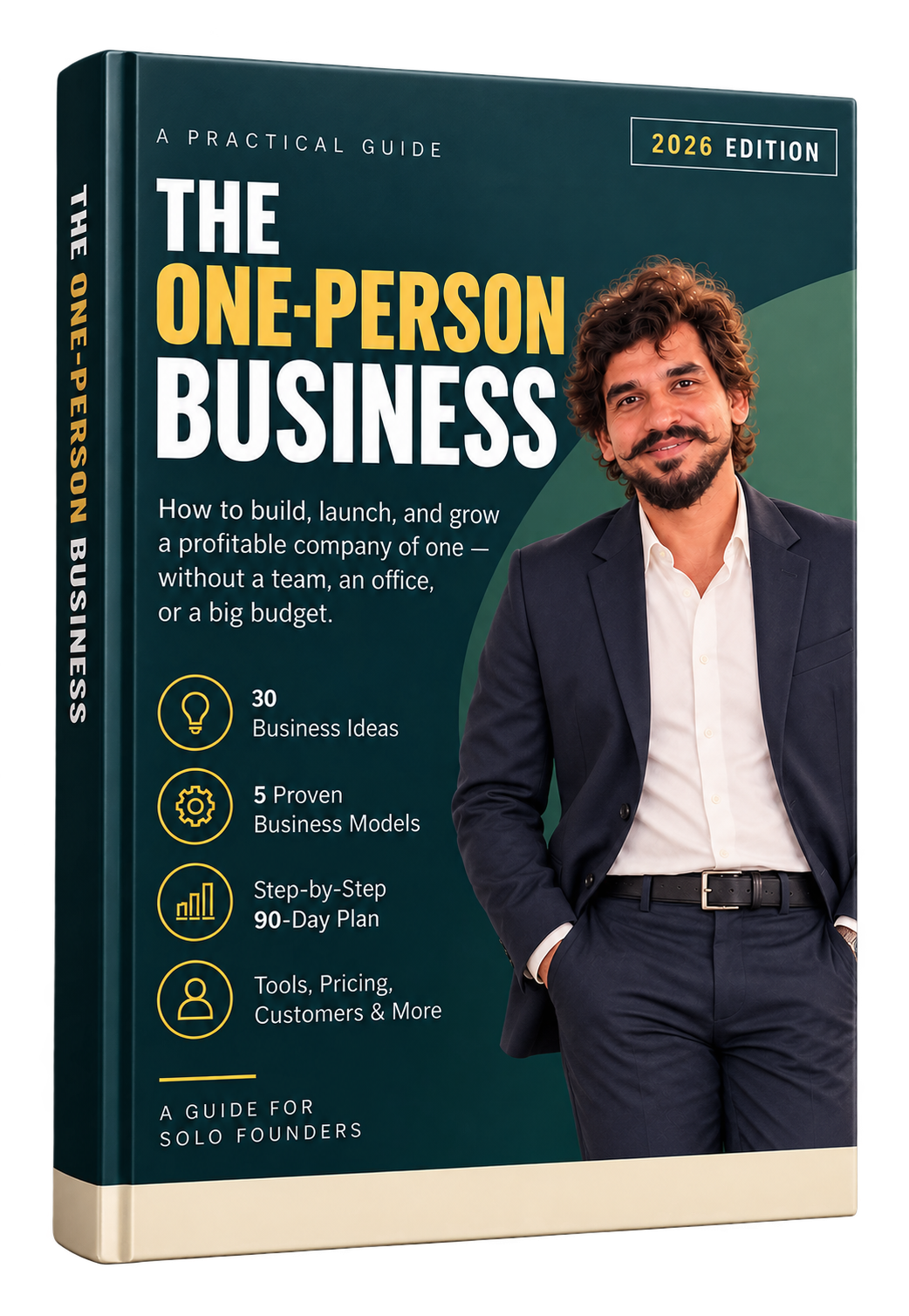
Build, launch, and grow a profitable one-person business — without a team, an office, or a big budget. A structured path from “I have no idea where to start” to a validated idea and a working 90-day plan.
Practical. Realistic. Built for solo founders. Instant download after purchase.
Starting something on your own rarely fails because there aren't enough ideas. It stalls because there are too many — and no way to tell which one is worth your next three months.
You need a path.
This book is that path — in sequence. Choose the shape of the business first, then the idea, then test it cheaply, then formalize, then find customers, then price it so it's actually worth doing.
Each phase builds on evidence from the one before it — not on enthusiasm.
Why growth and headcount came apart — and what that changes for someone starting today.
The honest trade-offs of staying solo, three mindset shifts, and a self-check on time, skills, and runway.
Pros, cons, and ideal fit for each model — so you choose the shape of the business before its content.
Organized by model, each with what it is and who it naturally fits — not a random list.
Four questions, a scored comparison worksheet, and the cheapest possible test for every model.
Structures, Udyam/MSME, GST, presumptive taxation, advance tax, and bookkeeping habits — explained plainly.
Nine functions, what each is for, and exactly when to add it — so you stop buying tools you can't justify.
Where early customers really come from, a weekly outreach rhythm, and how to lead with an outcome.
Hourly, fixed-fee, and value-based pricing; a minimum viable rate; and the mistakes that quietly cost the most.
What to systemize, what to automate, what to keep personal, and how to set the boundaries a team would.
Three phases, week by week, ending in a written 90-day commitment you fill in yourself.
A one-page checklist: this week, weeks 2–4, once you have your first client, and every week after.
Nearly every solo business falls into one of five shapes. Each has a different relationship between your time and your income — and knowing which one you're in saves months of second-guessing.
A skill packaged into a fixed-scope, fixed-price offer instead of open-ended hours.
Selling time and expertise directly — the fastest path to a first payment of any model.
Courses, templates, guides, tools — built once, sold repeatedly, marketed continuously.
Selling a result rather than hours, through structured programs and engagements.
The content is the business: a newsletter, channel, or niche publication that compounds.
The book also maps your priority — fastest income, highest ceiling, deepest relationships — to the model that fits it.
Get the Ebook →Each one comes with what it actually is, how it gets paid, and the kind of person it suits. A sample:
30 ideas. Five business models. One goal: find a business you can actually see yourself running.
You don't need certainty before you start — you need enough evidence to justify the next small step. Four questions turn a shortlist into a decision.
The book includes an Idea Comparison Worksheet — score each idea 1–5 on all four questions, total it out of 20, and write down the one concern you'd test cheapest. Validation comes before registration.
Not to build the real version — just the smallest version that proves someone wants it.
Days, weeks, or months — neither answer is wrong, but choose it knowingly.
What a good year honestly looks like, and the minimum that still makes it worth your time.
Some ideas quietly require hiring once they get traction. If staying solo matters, cross them off.
A template, not a rigid schedule — adjust the pacing to your idea and your available hours, but keep the sequence.
Excerpts from three pages — the trade-offs table, the comparison worksheet, and the cheapest-test table.
Score each idea 1–5 on all four questions, then total it out of 20.
The book says plainly what most of this genre won't: almost nothing here is truly passive. A digital product that sells while you sleep still needs you to build it, market it, update it, and answer customer questions.
Six-figure solo incomes are real, but they're the outcome for a minority — most solo operators build steady, meaningful, more modest income, and the book treats that as a perfectly good result.
Being honest about the fit is the point — the book takes the same approach with every business model in it.
2026 Edition · Instant download (PDF) after purchase
Digital download. No team, office, or budget required to start.
Chapter 5 is written specifically for solo founders in India: choosing between a sole proprietorship, OPC, LLP, or Private Limited; Udyam/MSME registration; PAN and Shop & Establishment; whether you actually need GST; presumptive taxation; TDS, advance tax, and filing; plus bookkeeping habits and basic protection from day one.
Educational information only — not legal, tax, or financial advice. Thresholds, section numbers, and rules change with every Union Budget; verify current requirements with a qualified professional before you register or file anything.
No. Several of the models can be tested for close to nothing — reaching out to ten potential clients, offering a package to five people you know, or publishing a few pieces of content. The book's position is to validate first and spend later; none of the suggested tests require a licence, a logo, or a finished product.
Yes — that's the case it's written for. Chapter 2 helps you choose a model, Chapter 3 gives you 30 ideas organized by that model, and Chapter 4 gives you a scored framework for narrowing them to one you'd actually stick with.
It's aimed at exactly that transition: moving from unbundled hours to productized offers, setting a minimum viable rate, fixing common pricing mistakes, building systems, and layering a digital product or content platform on top of client work over time.
No. Every idea and structure in the book was chosen because one person can run it, at least at the start. Where an idea eventually needs help to keep growing, the book flags it honestly so you can decide up front.
No — and it says so directly. Almost nothing in the book is truly passive; even digital products need building, marketing, updating, and customer support. What it offers instead is a realistic map of the terrain and the practical scaffolding to go from zero to a working business.
Yes. Chapter 10 is a 90-day plan in three phases — choose and validate, build and formalize, launch and learn — followed by a written 90-day commitment you fill in, and a one-page Start Here checklist.
No. Chapter 5 is educational information for solo founders in India, and the book says plainly that rules change with every Union Budget. Confirm anything you plan to act on with a qualified professional before registering or filing.
Checkout happens on a secure payment page. Once payment succeeds you're taken straight to a download page for the PDF — keep it somewhere you can get to easily and start with the Start Here checklist.
It can start with an idea, a skill, a customer problem — and a plan for the next 90 days.
Get the EbookInstant digital download (PDF). As a digital product, payments are non-refundable once the purchase is completed, except where required by law.
How to build, launch, and grow a profitable company of one — without a team, an office, or a big budget. 2026 Edition.